
After Tax Season Planning: How to Avoid This Next Year
April 15 has come and gone — and honestly, for a lot of people, this is when the anxiety sets in. Not before. After.
Maybe you filed and something feels off. Maybe you filed an extension and haven’t looked at it since. Maybe you haven’t filed at all. Or maybe you owe more than you expected and you’re not sure where to go from here.
Whatever your situation, here’s how to think through it.
If you haven’t filed yet
Don’t sit on it.
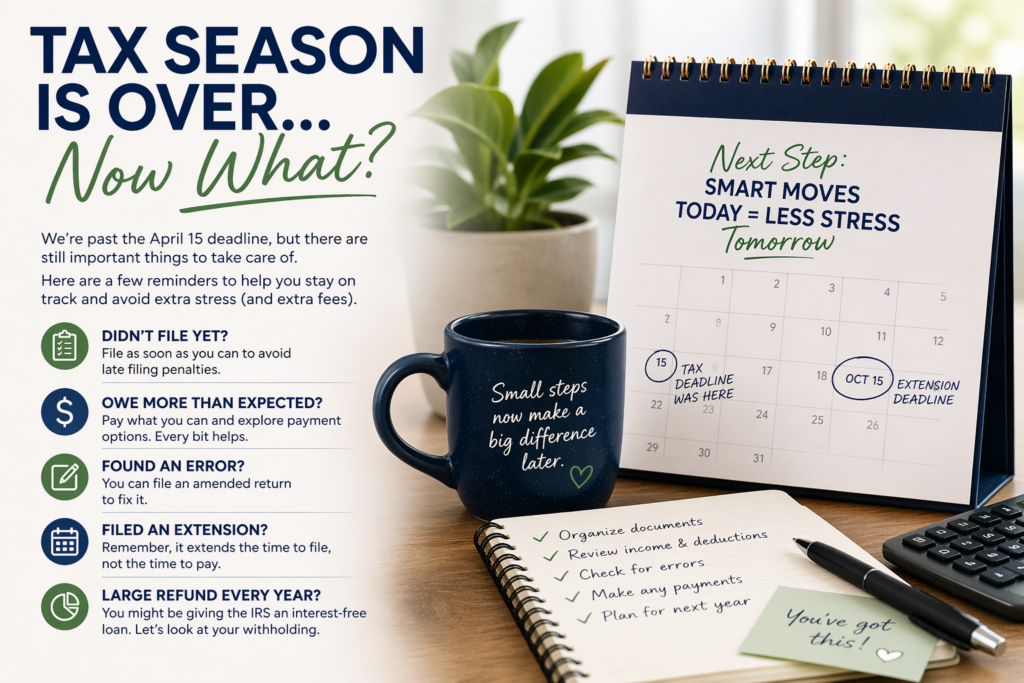
File as soon as you can. If you submitted an extension, you have until October 15 to file — but that extension only bought you more time to file, not more time to pay. If you owed money on April 15, interest and penalties started accumulating that day.
If you owe and can’t pay in full
This is more common than you’d think, and you have real options.
You can pay whatever you can right now to reduce penalties. You can set up a payment plan directly with the IRS. You can explore short-term options if you need breathing room.
The worst thing you can do is nothing. The IRS is significantly more flexible when you’re proactive — they’re far less forgiving when they have to come looking for you.
If you’re worried about penalties
There are two that matter most:
The late filing penalty hits hard and adds up fast. The late payment penalty is smaller but compounds monthly.
That’s why filing — even when you can’t pay the full balance — is almost always the right move. The filing penalty is the one that will cost you.
If you found a mistake after filing
It happens. More often than people realize.
You can file an amended return to correct errors, add missed income, or capture deductions you left on the table. You generally have three years to do it — but sooner is better. Don’t let a fixable mistake sit.
If you’re expecting a refund
If you e-filed with direct deposit, you’re typically looking at a couple of weeks. Paper filings take considerably longer. You can check the status anytime at irs.gov using the “Where’s My Refund” tool.
If you filed an extension
Start now — not in September.
October 15 will arrive faster than you think, and the smoothest filings happen when you’re not rushing. Get your documents organized. Review your income and deductions. If you owe, making payments now reduces what you’ll owe in interest later.
Looking ahead — this is actually the best time to plan
Here’s what most people miss: the weeks right after tax season are the best time to set yourself up for next year.
If you got a large refund, that’s money you were essentially lending to the IRS interest-free all year. It might be worth adjusting your withholding so that money stays in your pocket throughout the year instead.
If you owed more than expected, let’s look at estimated payments or withholding adjustments now — before the same thing happens again next April.
Final Thought
Tax season doesn’t end. It transitions.
What you do in the next few weeks — filing, fixing, planning — is what determines how smooth or stressful next year looks. The people who feel good at tax time aren’t lucky. They just didn’t wait.
If you want to talk through your specific situation, now is genuinely one of the best times to do it. Schedule a call at nedapro.com.
About the Author
Neda Essa, CPA, is the founder of NedaPro, a CPA-led advisory firm supporting SaaS and growth-stage companies with finance, tax, revenue, and operational architecture. She specializes in helping organizations build scalable systems, strong controls, and clarity as they grow.